For years, domains that exactly matched popular keyword phrases were seen as an easy way to gain an SEO advantage. That changed when Google began limiting the visibility of low-quality websites that relied heavily on exact match domains. Since then, the choice between a keyword-focused domain and a more distinctive brand name has depended much more on the business goals and long-term strategy.
Today, exact match domains can still rank successfully, but the presence of a keyword in the name is not enough to explain strong positions on its own.
If you are choosing a domain for a new website, it is important to consider what practical benefits such a name can provide and whether they justify a higher purchase price or potential limitations on the future development of the brand.
Key Takeaway:
Exact match domains can still be useful for SEO in 2026, but simply having a keyword in the domain name does not lead to better rankings on its own. Google uses domain words as one of many relevance signals, while content quality and usefulness, site authority, and alignment with search intent carry far more weight. An EMD can therefore support an SEO strategy, but it cannot compensate for weaknesses in its other elements.
How Do Exact Match Domains Work?
With this type of domain, the name fully matches the keyword phrase the website is targeting. For example, the domain avtozastrahovki.bg directly matches the Bulgarian search term “автозастраховки” (“car insurance”) without including an additional brand name or other words.
This approach became popular in SEO because the domain name itself clearly communicated the main topic of the website. In the past, such a match could also have a more noticeable influence on rankings, making these domains attractive to businesses and niche websites focused on specific products, services, or search queries.
What Is the Difference Between Exact Match, Partial Match, and Branded Domains?
A partial match domain contains the main keyword together with additional words or a branding element. A branded domain, on the other hand, may not contain the keyword at all and instead relies on its own distinctive identity.
For example, for a website targeting the Bulgarian keyword “автозастраховки” (“car insurance”), the three approaches could look like this:
- Exact match: avtozastrahovki.bg
- Partial match: moitezastrahovki.bg
- Branded name: sigurno.bg
The difference lies in how closely the domain name matches the target keyword. None of these approaches is automatically better for SEO, since the choice of domain name is only one of many factors that can influence a website’s performance.
How Does Google Evaluate Keyword Domains?
In the past, exact match domains could gain a significant SEO advantage, even when the website itself did not offer particularly high-quality content. In September 2012, Google introduced an algorithm update aimed specifically at reducing this effect for low-quality websites whose domains matched search queries.
The change did not mean that using a keyword in a domain became a negative SEO signal. Its purpose was to ensure that the match alone was not enough to secure high rankings for a website that otherwise failed to provide sufficiently useful and high-quality content.
The same principle still applies today. According to Google’s current documentation, words in a domain name are one of many factors used to determine relevance to a search. At the same time, the exact match domain system limits the weight of this signal so that a website does not receive excessive credit simply because its domain matches a specific query.
What SEO Value Does a Keyword in the Domain Provide?
A keyword in the domain name can help Google understand the website’s topic, but it is not enough on its own to achieve better rankings. As discussed above, Google considers words in a domain as a relevance signal, but it evaluates pages based on many additional factors.
This means a website does not need an exact-match domain to rank successfully for a particular keyword. Google can associate content with a topic and search intent regardless of whether the exact phrase appears in the domain name.
In practice, what matters more is whether the page satisfies the search and provides useful, reliable, and sufficiently detailed information. Site authority, internal and external links, technical performance, and overall user experience can also have a much greater impact than choosing an exact match domain.
A relevant keyword in the domain can therefore act as an additional topical relevance signal, but it should not be the main reason for choosing a name.
When Does It Make Sense to Choose an Exact Match Domain?
An exact match domain can be a good choice when the keyword phrase naturally describes the business and the name would still make sense even without any potential SEO benefit. This is particularly relevant for websites focused on a clearly defined topic, product, or service that do not plan to expand significantly beyond that niche.
Such a domain may be suitable when:
- The keyword clearly describes the product or service. Users can understand what the website offers directly from the domain name without needing further explanation.
- The website focuses on a specific niche. For a specialized business or project, the domain can naturally reflect the main topic and reinforce its positioning.
- The name is short and easy to remember. A keyword match has little practical value if it makes the domain overly long, complicated, or difficult to type.
- The domain does not limit future business growth. A highly specific name can work well if the company intends to stay within the same niche, but it may become a disadvantage if the business later expands into other products, services, or markets.
- The name sounds natural outside Google. A good domain should also work as a name you can easily use in advertising, social media, email communication, or conversations with customers.
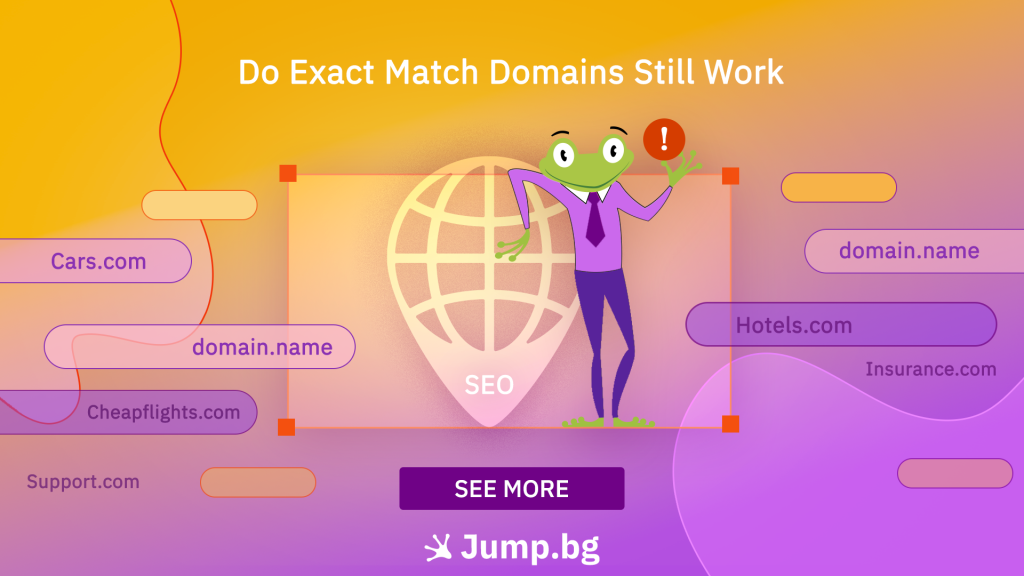
Good examples of this approach include Hotels.com, Cars.com, Insurance.com, and Cheapflights.com. In each case, the domain clearly indicates what the website offers, while the name has also developed into a recognizable brand over time. This illustrates one of the situations in which an exact match domain works best: when the keyword is not chosen solely for SEO, but can also function naturally as the name of the business itself.
When making the decision, it is therefore better to first consider whether the domain fits the business and its long-term direction. If it also contains a relevant keyword, the potential SEO value can be treated as an additional benefit.
Conclusion
Choosing a domain is a decision with a much longer lifespan than individual search engine algorithm changes. A well-chosen name should be easy to remember, clearly represent the business, and leave enough room for future growth. If those qualities are combined with a natural match to an important keyword phrase, an exact match domain can be a sensible choice without SEO being the only reason for registering it.
If you are ready to register a suitable name, at Jump.BG we offer domain registration across a wide range of extensions, including .com, .bg, .net, .org, .de, .io, and many others. We also offer domain transfer and renewal options, with listed prices including VAT, so you can choose an extension that fits your project and naming strategy.
If you have questions about choosing or registering a domain, our team is available at 02 428 8888 or support@jump.bg.